
Criminal records reveal the legal history of an individual, and in Kern County those files are organized for quick public access through the Kern County criminal record database. Whether you need Kern County criminal records by name, by case number, or by date of birth, the online search portal pulls data from the Kern County public criminal records system, showing arrest information, conviction details, sentencing, and case disposition. Users often start with a Kern County criminal record lookup to verify felony charges, misdemeanor offenses, or pending criminal cases, and the results include court case numbers, offense classification, and probation status. By entering the required identifiers, you can instantly see Kern County criminal case records, see if a record is sealed or expunged, and understand the current case status without visiting the courthouse.
Criminal records search in Kern County also supports detailed queries such as Kern County criminal records by date of birth or by case number, delivering comprehensive criminal charge records and arrest history. The system distinguishes between active, closed, or dismissed cases, and highlights any pending criminal cases or acquittal outcomes. For those needing certified copies, the Kern County official criminal records request process offers official criminal record information with verified accuracy, helping employers, landlords, and legal professionals obtain reliable background verification while respecting privacy rules and public record statutes.
How to Search Criminal Records
You can search Kern County criminal records online through the Kern County Superior Court’s case search tool. The portal is open to the public by reviewing official public records, free to use, and pulls from live court files. You do not need to create an account or install software to use the search. Each result links to a full case file with charges, hearings, and rulings.
Official Search Portal: https://www.kern.courts.ca.gov/online-services/case-information-search
Steps to Search
- Open the Kern County Superior Court case search page in your browser.
- Pick the search type from the menu: name, date of birth, or case number.
- Type the person’s full legal name, date of birth, or case number in the search box.
- Choose “Kern County” from the court location list to narrow the results.
- Click the search button and wait for the system to load the case list.
- Read the case list, then click the case number for full case details.
- Write down the case number, court location, and next hearing date if needed.
Search by Name
Searching by name is the most common way to look up Kern County criminal records. The system checks both first and last names against court files. You should type the last name first, then the first name, to get the best results. If the name is common, you may see many entries that need sorting.
Search by Date of Birth
A date of birth search gives you a much tighter set of results than a name search alone. When you add the year, month, and day, the system filters out anyone who shares the same name. This method works best when you have a full name and want to confirm you pulled up the right person. You should use the date of birth listed on a government ID for the best match.
Search by Case Number
If you have a case number from a citation, court paper, or legal notice, you can skip name searches. A case number search is the fastest way to open one case file. You type the full case number exactly as printed, with no spaces or dashes missing. The system shows all filings, hearings, and rulings tied to that case number.
Search by County or Jurisdiction
Kern County criminal cases are kept by the Kern County Superior Court. Smaller cities in the county may have their own court files too. When you start a search, pick “Kern County” from the court location list to see all local cases. Picking the wrong county is a common reason people see “no record found.”
Information Needed for a Search
Before you start, gather any facts you already have about the person or case. A full legal name, date of birth, and case number will give you the best results. Even one piece of data helps the system narrow the search list. The more you add, the faster you find the right file.
- Full legal name (first and last)
- Date of birth (year, month, day)
- Case number (year, court code, sequence)
- Court location (city or county)
- Approximate arrest year
Kern County Record Details
A Kern County criminal record shows the key facts about a person’s contact with the local court system. Each record covers the case history from arrest to final outcome. The level of detail depends on the case type and where the case sits in the court process. You can see most of these details through the online portal without paying a fee.
Person Identification
The record shows the full legal name of the person tied to the case. It may list known aliases, date of birth, and a booking photo. This data helps you confirm you found the right file. If you see aliases, the person used other names during arrests or court hearings.
Arrest Date and Agency
Each record shows the date the person was arrested and the arresting agency that handled the booking. Kern County arrests are often processed by the Kern County Sheriff’s Office or a city police department. The arrest date is helpful when you need to check old records or confirm a timeline of events.
Criminal Charges
The charges section lists every criminal charge tied to the case. Each charge has a code, a short description, and the statute it falls under. You can see if the charges are felonies, misdemeanors, or infractions. Reading the charge list gives you a clear picture of what the person was accused of doing.
Offense Classification
California law sorts criminal acts into three main classes: felonies, misdemeanors, and infractions. Felonies are the most serious and can lead to state prison time. Misdemeanors carry up to one year in county jail. Infractions are minor and usually mean a fine. The classification shapes the court process, the outcome, and what shows up on the record.
Case Number and Court
Every criminal case in Kern County gets a unique case number when the district attorney files charges. The case number uses a year code, a court code, and a case type code. You need this number when you request certified copies or follow up at the courthouse. The court location tells you which courthouse handled the case.
Disposition
The disposition is the final outcome of the criminal case. It tells you whether the person was convicted, acquitted, or had the case dismissed. Other outcomes include diversion programs, plea deals, or civil compromises. The disposition is one of the most checked fields on any criminal record.
Sentence
If the case ended in a conviction, the record lists the sentence the judge gave. Sentences may mean time in jail, prison, probation, fines, or community service. The record may also show parole or probation terms. This data is useful for background checks, legal work, and personal records.
Types of Criminal Records
Criminal records in Kern County fall into a few main types based on the charge and the outcome. Knowing the type helps you find what you need faster. Each type has its own search path and its own data fields.
Felony Records
Felony records cover the most serious criminal charges, like robbery, assault with a deadly weapon, or drug sales. A felony conviction can lead to state prison time of more than one year. These records stay on a person’s court file unless they are sealed or expunged. Many employers and licensing boards check felony records as part of their screening.
Misdemeanor Records
Misdemeanor records cover less serious offenses like petty theft, simple assault, or first-offense DUI. A misdemeanor conviction can carry up to one year in county jail. These records show up on background checks, but some can be dismissed after a diversion program. You can search for misdemeanor records the same way you search for felonies.
Arrest Records
Arrest records show that a person was taken into custody by police. An arrest record does not mean the person was convicted of a crime. The record shows the arrest date, the agency, and the charges at the time of booking. Many arrest records stay on file even if the case was later dismissed.
Conviction Records
Conviction records show that a person was found guilty of a crime. The conviction can come from a guilty plea, a no-contest plea, or a trial verdict. The record lists the charge, the sentence, and any fines or probation terms. Conviction records are the ones most often checked by employers, landlords, and licensing boards.
Pending Case Records
Pending case records are open cases that have not reached a final outcome yet. They show the charges, hearing dates, and the next court action. A pending case does not mean the person is guilty, only that the case is still moving through the court.
Dismissed Case Records
Dismissed case records show that the court dropped the charges. The case may be dismissed because of lack of evidence, a plea deal, or a diversion program. Dismissed records still appear in court files unless they are sealed or expunged.
Historical Records
Historical records are older cases that closed many years ago. They sit in the court archive system and may take longer to pull up online. Some older records may only be available at the courthouse. You can still search for them using the person’s full name and date of birth.
Criminal Record Status
Each criminal record has a status that shows where the case sits in the court process. Knowing the status tells you if a case is still open, closed, or sealed. This data is useful for background checks and legal work.
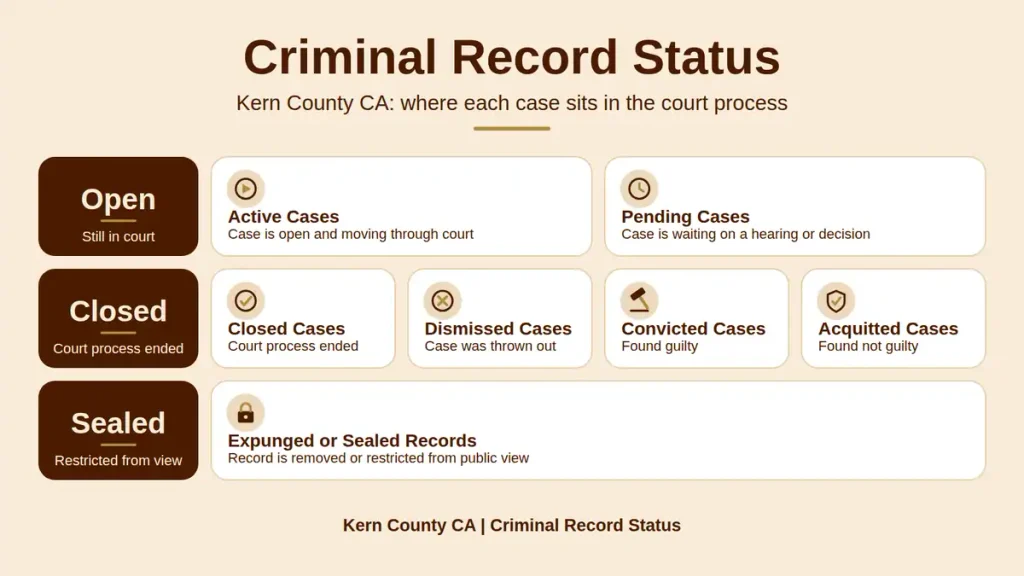
Active Cases
Active cases are open matters still moving through the court. They have upcoming hearings, motions, or trials. You can see the next court date and the type of hearing on the case file.
Pending Cases
Pending cases are similar to active cases. They mean the court has not reached a final outcome. The case is waiting for a hearing, plea, or trial verdict.
Closed Cases
Closed cases have reached a final outcome. The record may show a conviction, dismissal, or acquittal. Closed cases stay in the court file unless they are sealed or expunged.
Dismissed Cases
Dismissed cases were dropped by the prosecutor or the court. The person was not convicted. The record still exists but shows the dismissal as the final outcome.
Convicted Cases
Convicted cases ended with a guilty plea or trial verdict. The record shows the conviction, the sentence, and any probation or parole terms.
Acquitted Cases
Acquitted cases ended with a not-guilty verdict at trial. The court found the person not guilty. The record still exists, showing the acquittal as the final outcome.
Expunged or Sealed Records
Expunged or sealed records are removed from public view by court order. You will not see them in a regular online search. Only certain agencies and courts can pull sealed records under California law. A sealed record still exists but is hidden from public search portals.
Records and Public Access
California law sets clear rules on what criminal records the public can see. Most criminal court files in through available residents directory resources, Kern County are public records. Some files are restricted or sealed by law. Knowing the rules helps you understand what you can and cannot access.
Publicly Available Records
Most felony and misdemeanor case files are public records in California. You can see the charges, pleas, hearings, verdicts, and sentences. The public access rule is set by the California Rules of Court and state public records laws.
- Felony case filings
- Misdemeanor case filings
- Court hearing dates
- Final case dispositions
- Criminal court sentences
Online Criminal Records
The Kern County Superior Court runs an online case search tool that shows public criminal records. You can search by name, date of birth, or case number. The online portal shows the same data available at the courthouse clerk’s office.
Restricted Details
Some data on a criminal record is restricted. Personal ID numbers, social security numbers, and certain witness names are not shown to the public. You also cannot see sealed records, juvenile records, or expunged records through the public portal.
Sealed Records
Sealed records are removed from public view by court order. You cannot see them in a normal online search. Only the court, police agencies, and certain state agencies can view sealed records under California law.
Juvenile Records
Juvenile criminal records are not open to the public in California. They are kept separate from adult criminal records. You can only see juvenile records through a court order or a special request under state law.
Records Available by Request
Some records need a written request to access. These include older archived files, certified copies, and certain sealed files. You can file a request at the Kern County Superior Court clerk’s office during business hours.
Obtaining Official Records
You have a few options for getting official criminal records in Kern County. The right option depends on why you need the record and how you plan to use it. Certified copies cost a fee, but regular online lookups are free.
Online Requests
The Kern County Superior Court lets you view criminal case data online for free. You can search by name, date of birth, or case number. Online records are not certified copies, so they may not work for legal filings or formal background checks.
Court Record Requests
You can file a court record request at the clerk’s office for a copy of a case file. The clerk will print the records you ask for and stamp them as official court documents. You must fill out a request form and pay the copy fee.
Agency Requests
Police agencies can pull criminal records as part of an investigation. They can share arrest records with other agencies through official channels. If you are part of a legal case, your attorney can ask the court to pull records through a legal request.
In-Person Requests
You can visit the Kern County Superior Court clerk’s office in person during business hours. You can search case files on the public terminals or ask the clerk for help. Bring a valid photo ID and any case data you have.
Certified Copies
Certified copies are stamped by the court clerk and accepted by courts, employers, and licensing boards. You can order certified copies at the clerk’s office or by mail. The court charges a fee for each certified copy.
Fees and Processing Times
Fees for certified copies vary by document type and number of pages. Most certified copies are ready the same day if you ask in person. Mail requests may take five to ten business days to process. Online case lookups are free and instant.
Accuracy and Limitations
Criminal records can hold errors. Names get misspelled, dates get entered wrong, and old records can stay on file years after a case is closed. Knowing the limits of each record helps you read the data right.
Verifying the Correct Person
Always check the date of birth and aliases to make sure you have the right person. A common name can pull up many people who share the same first and last name. Cross-check the date of birth, address, and case number before you act on a record.
- Full legal name
- Date of birth
- Known aliases
- Last known address
- Case number
Name Matches
If you search a name that is shared by many people, you may see dozens of results. Use the date of birth, middle name, or case number to narrow the list. Common names like “John Smith” or “Maria Garcia” often pull up many records.
Matching Case Numbers
Case numbers are unique, so they are the most reliable way to pull one file. Always match the year code, court code, and case type code. One wrong digit can pull up the wrong case file.
Duplicate Records
Some people have more than one record for the same case. This can happen when a case is reopened or transferred. The court may show two entries for the same arrest. Look at the case number and court location to spot duplicates.
Outdated Information
Some online records may be out of date by a few days. New hearings, plea deals, or dismissals may not show up right away. If a record looks old, contact the court clerk to confirm the latest status.
Missing Records
Some records may be missing from the online system. Older cases, sealed files, and expunged cases may not appear. If a record is missing, you can file a request at the clerk’s office to search the archive.
Differences Between Record Sources
Different agencies keep different records. The court keeps case files, the police keep arrest records, and the jail keeps booking records. Each source may show different data for the same event. The court file is often the most complete public source.
Criminal Records Search Problems
Search problems are common, and most have simple fixes. Knowing the common issues saves you time and helps you get the right record faster.
No Record Found
A “no record found” result does not always mean they have no criminal record. The search may have used the wrong spelling, the wrong date of birth, or the wrong county. Try the search again with different spellings or with the full case number.
Incorrect Name or Spelling
Names get misspelled in police reports and court filings. A small typo can hide the record. Try common misspellings, aliases, and former married names when you search.
Incorrect Case Number
If you have one digit wrong in a case number, you will get the wrong file. Double-check the year code through available sex offenders registry resources, the court code, and the case sequence number. A simple typo is the most common search error.
Wrong County or Jurisdiction
Criminal cases are filed in the county where the arrest or crime happened. If you search the wrong county, you will see “no record found.” Always confirm the county from the arrest record or court paper.
Missing Information
If you don’t have a date of birth or middle name, the search list may be too wide. Use what you have and check each result for matching data like age, address, or case type.
Restricted Records
Sealed records, juvenile records, and expunged records will not show up in a public search. If you have legal authority, you can file a request to view sealed records.
Delayed Updates
New court actions may not show up in the online portal right away. It can take a few days for new filings to appear online. If you need the latest data, contact the court clerk.
Contact Details
You can reach the Kern County Superior Court clerk’s office using the contact details below. The clerk’s office handles public records, certified copies, and case searches. You can also visit the courthouse during business hours for in-person help. Call the clerk’s office during business hours if you need help with a search, certified copies, or sealed records. You can also visit the courthouse in person at the address above to search the public terminals or file a paper request.
Frequently Asked Questions
Criminal records in Kern County give you a clear view of legal history for individuals or cases. Knowing how to locate these records helps with background checks, legal research, and personal peace of mind. The county court’s online case search tool makes the process fast, free, and open to anyone with internet access.
How can I search Kern County criminal records online?
Visit the Kern County Superior Court case search page at https://www.kern.courts.ca.gov/online-services/case-information-search. Enter a name, case number, or birth date. Results show charges, hearing dates, and outcomes. Click a result to view the full docket. No account or fee is required, and the site updates daily.
What information appears in a Kern County criminal record lookup?
A record lists the offender’s name, date of birth, and case number. It includes each charge, classification (felony or misdemeanor), court dates, and final disposition such as conviction, dismissal, or acquittal. Sentencing details, probation terms, and incarceration dates also appear when available.
Can I request Kern County criminal records by mail?
Yes. Write a request to the Clerk’s Office at 1415 Truxtun Avenue, Bakersfield, CA 93301. Include the subject’s full name, birth date, and any known case numbers. Attach a signed statement of purpose and a check for the filing fee. The office processes mail requests within 10‑15 business days.
How do I find Kern County for a specific case number?
Enter the case number in the search field on the online portal. The system pulls the exact docket, showing all filings, motions, and judgments linked to that number. If the case is sealed or expunged, the portal will display a notice that the record is not publicly accessible.
What steps should I take if a Kern County is missing or outdated?
First, verify the spelling of the name and double‑check birth date or case number. If the record still does not appear, contact the court clerk at (661) 610‑6000 to confirm whether the file is still pending or has been sealed. Request a certified copy if you need an official version for employment or licensing.